

Decoding the Odds from High School Elite Hooper to the NBA
Transition rates from high school rankings (ESPN 100/Rivals 150) to collegiate and professional success

In the previous post, we outlined the probability of going from NCAA college basketball to the NBA Draft and professional basketball.
So, what percentage of NCAA hoopers go pro?
It depends. Across the entire NCAA (D1, D2, D3) a mere 1% have their name called at the NBA Draft …but almost half (48%) will get an opportunity to play professionally in either the NBA (21%), G-League or internationally.
Nearly two-thirds of players (63%) who played in the major conferences (ACC, Big Ten, Big 12, Pac-12 and SEC) will play professionally, and about 85% of NCAA Division 1 Consensus All-American men’s basketball players from 2010-2020 were selected in the NBA Draft.
But we missed a step on the ladder when ascending to the college and professional ranks for American hoopers. The high school ranks.
Probability of Transitioning from High School to College to NBA
Recent data shows about 540,000 high school boys participated in basketball. About 3.6% will go onto play NCAA basketball (1% D1, 1% D2, 1.5% D3), and similar percentages will also play NAIA and JUCO.
And far fewer will play in the NBA or professionally (approximately less than 0.01% = 60 NBA draft choices / 540,000).
The Elite High Schoolers
It was noted above that about 85% of NCAA Division 1 All-Americans get selected in the NBA Draft.
What about high school All-Americans? What is their journey to the NBA?
As I’ve mentioned in other related posts, my mind has been on the development of the youth elite basketball player as I write a book chapter on the topic. This got me thinking of the ESPN Top 100 or Rivals 150 rankings and then the McDonald’s All-Americans.
The McDonald’s All-American Game is widely considered the “coronation” of the high school basketball elite. Since its inception in 1977 (which included Magic Johnson), it has served as the ultimate filter for the basketball ecosystem, separating the hundreds of high-level, 4- and 5-star prep recruits from the handful of “can’t-miss” professional prospects.
To be selected as one of the 24 boys for the annual roster is more than just an invitation to an all-star game. It is a permanent credential that now dictates a player’s market value, NIL (Name, Image, and Likeness) potential, and draft stock before they even step onto a college campus.
The Transition from Elite High School Prospect to NBA
The transition from elite high school prospect to NBA professional is a steep funnel where physical “projection” often matters more than high school statistical production. Analyzing data from the 2000–2020 era, we see a dramatic drop-off in success rates as you move down the rankings.
For a typical high school class of the top 150 players, the probability of hearing their name called on draft night—and more importantly, playing in the league—breaks down as follows.
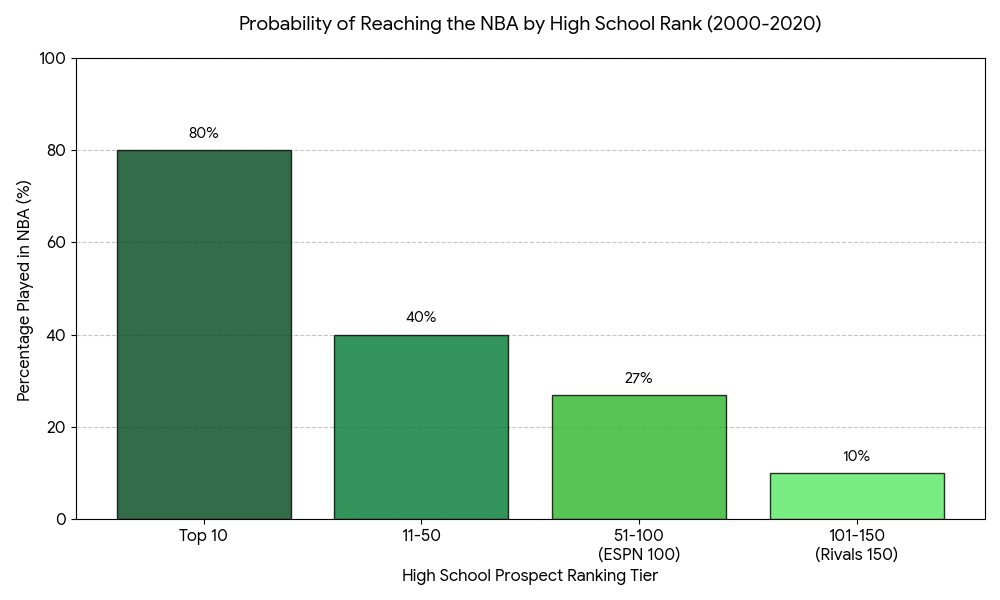
Key Insights from the Data
The “Top 10” Guarantee: If a player is ranked in the top 10 of their high school class, they are essentially a “pro-in-waiting.” Historically, 84% of these athletes make it to the league.
The ESPN 100 “Cliff”: While being a “Top 100” player is a massive achievement, the odds of actually playing in the NBA for the bottom half of that list (ranks 51–100) drop to nearly 1 in 4.
The Rivals 150 Gap: For players ranked 101–150, the draft rate plummets. These players are roughly 4 to 5 times less likely to be drafted than a 5-star recruit.
The Emergence of "Late Bloomers" and International Talent: One reason for the low conversion rate in the 101–150 range is the emergence of “Late Bloomers” and International talent. In a typical draft of 60 players:
~30–35 spots are taken by the “Top 100” high school recruits.
~10–15 spots are taken by international prospects who were never ranked in US high school lists.
~10–15 spots are taken by college “sleepers”—players who were unranked or 3-stars in high school but underwent significant development in college (e.g., Damian Lillard or CJ McCollum).
Going Pro: The Stark Reality
The data reveals a stark reality: high school rankings are a powerful predictor of professional success, but they are not an absolute destiny.
While the Top 10 high school basketball players in a given year functions as a near-guaranteed “pro-in-waiting,” the path for everyone else is a high-stakes battle against global and late-blooming talent.
Once you move past the Top 50, the draft becomes a zero-sum game where “projected” potential often outweighs “current” high school production. For those in the Top 100-150 or unranked “sleeper” categories, the message is clear: the traditional domestic pipeline is shrinking. To secure one of the few remaining draft slots, these players must undergo significant development in college to leapfrog the international prospects and elite recruits who are already standing in the doorway.
Statistics in this blog were generated by Gemini, e.g., response to “determine the nba draft rate and playing in NBA of ESPN 100 and Rivals 150 players from 2000-2020” March 23, 2026, Google Gemini. Note: Always verify AI-generated stats against primary sources (like ESPN 100 and Rivals 150).
Interested in the science of basketball? Check out the following series.


