

Growing into Velo: A Longitudinal Case Study of the Physical Growth & Maturation of a Late Maturing MLB Pitcher
The Slade Cecconi Story

JC Eisenmann. Growing into Velocity: A Longitudinal Case Study of the Physical Growth & Maturation of a Late Maturing MLB Pitcher. Archives of IronMan Performance. Vol 1, 2026. [joeeisenmann.substack.com]
This article is another in a series shedding light onto the changes in physical growth and maturation and fastball velocity of baseball pitchers. The focus of this paper is a case study of a late maturing MLB pitcher - Slade Cecconi, currently with the Cleveland Guardians.


Methods
As part of a larger study, publicly available data were gathered on professional baseball pitchers from the websites of Perfect Game, a baseball scouting service (observation date, height, weight and fastball velocity); Baseball-Reference.com, a baseball statistics database (date of birth, current height and weight); and Baseball Savant, a baseball analytics platform (current fastball velocity).
Data were managed and analyzed in Google Sheets. This included the calculation of chronological age [(Observation date minus DOB)/365], derivation of growth rates (expressed in units per yr, e.g. inches per yr) and the percent (%) of adult height. The % adult height has become a common proxy for maturity status.Note: the average age of peak height velocity (PHV) of boys is about 14 yrs. A common guide for an average maturer is as follows: pre-growth spurt (%PAH <85%); take-off/early phase of growth spurt; pre-PHV (85-89%); mid-late growth spurt (89-95%); and post-growth spurt (>95%).
Limitations
Data obtained from website and unknown how assessed. In many cases, it was likely self-reported. This clearly impacts the accuracy of the data, including the magnitude of growth rates; however, it likely provides a general trend in the growth pattern of the individual.
Training of the athlete is unknown. This includes type of training (throwing, pitching lessons, resistance training, etc.) and volume and intensity of training.
Case Study
Slade Cecconi was born on 06/24/1999 and grew up in central Florida. As a 14-yr old, he was 5-6, 137 lbs (self-described as “pudgy” in the podcast referenced here). He is currently listed on Baseball Savant as 6-4, 219 lbs; however, on a recent Cressey Performance Elite Baseball podcast mentions he is hovering around 240 lbs.
In this same podcast, he also mentions how at the ages of 13-15 years how baseball became quite challenging - as most of the other ballplayers were experiencing the adolescent growth spurt, leaving him smaller and less physically mature compared to his peers. Indeed, based on the available data, and his own recall on the podcast, Cecconi was a late maturer.
Let’s take a closer look into his growth trajectory from age 14 to 18 years.
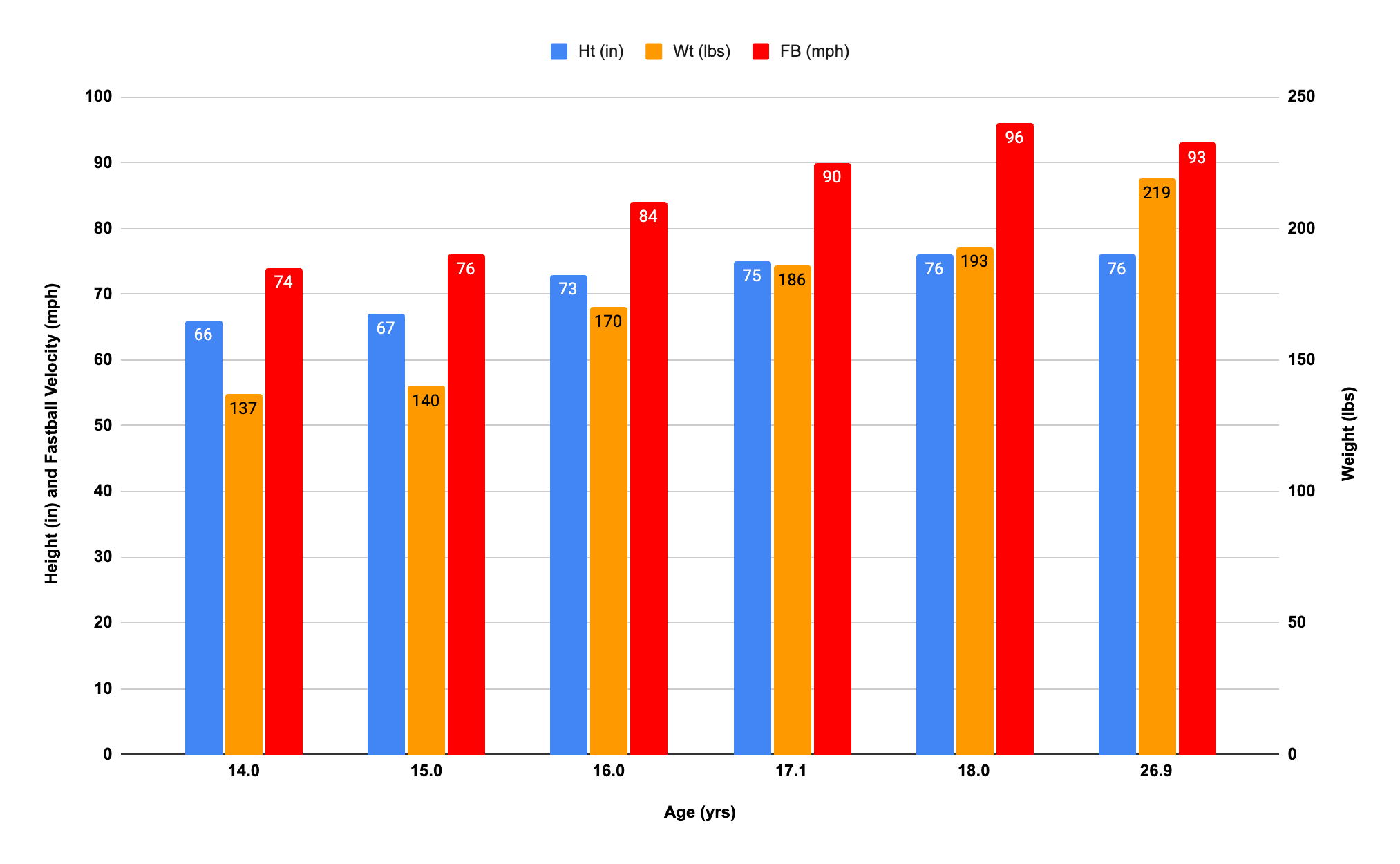
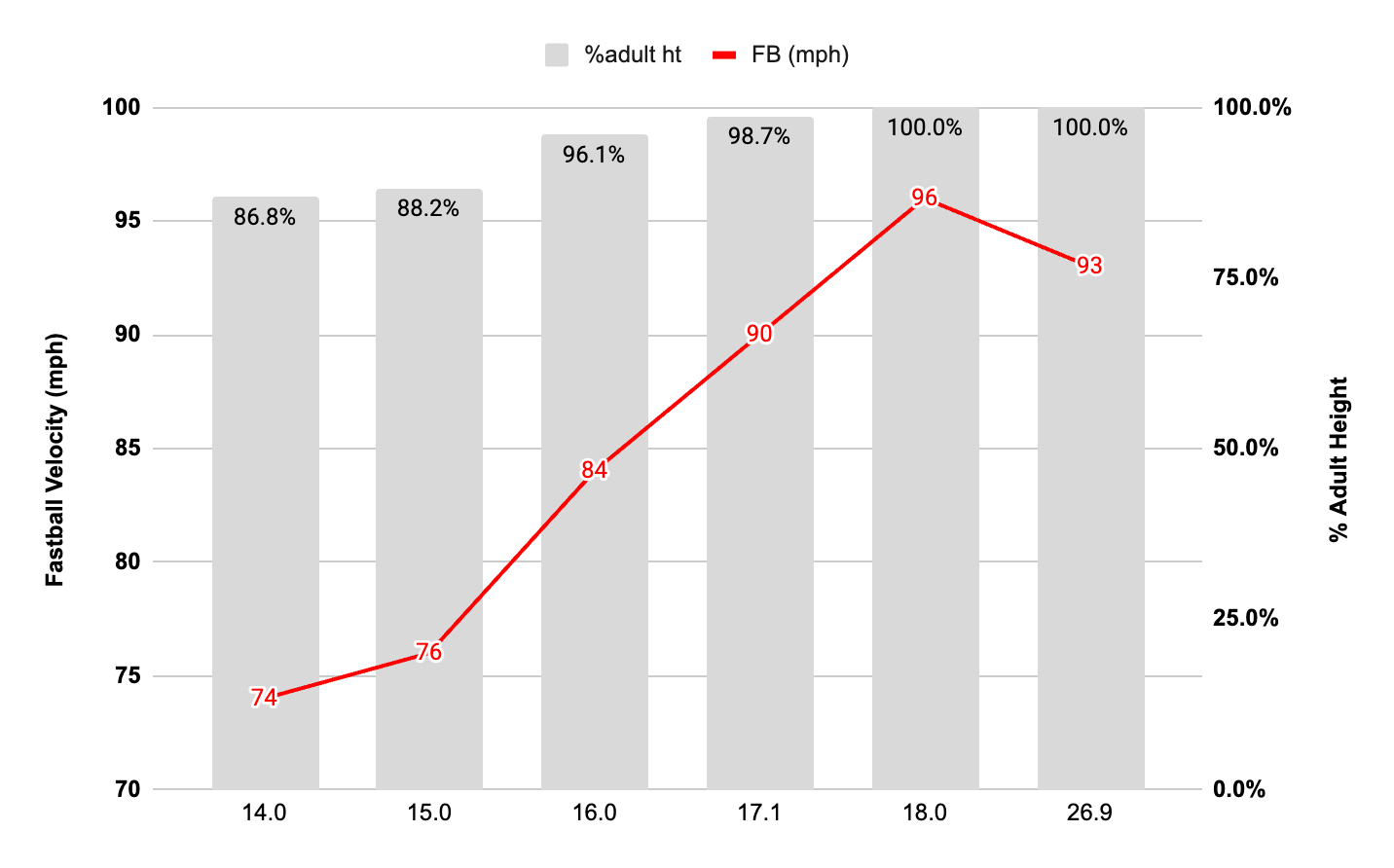
At the age of about 14 years, the growth spurt was perhaps initiated (this is also referred to as “take-off”), and the estimated age at PHV was attained at about 15.2 years of age. For reference, an average maturing boy will attain PHV at about age 14 years. Typically a band of 0.5 or 1.0 years plus-or-minus the average age of PHV will be used to categorize as an early or late maturer.
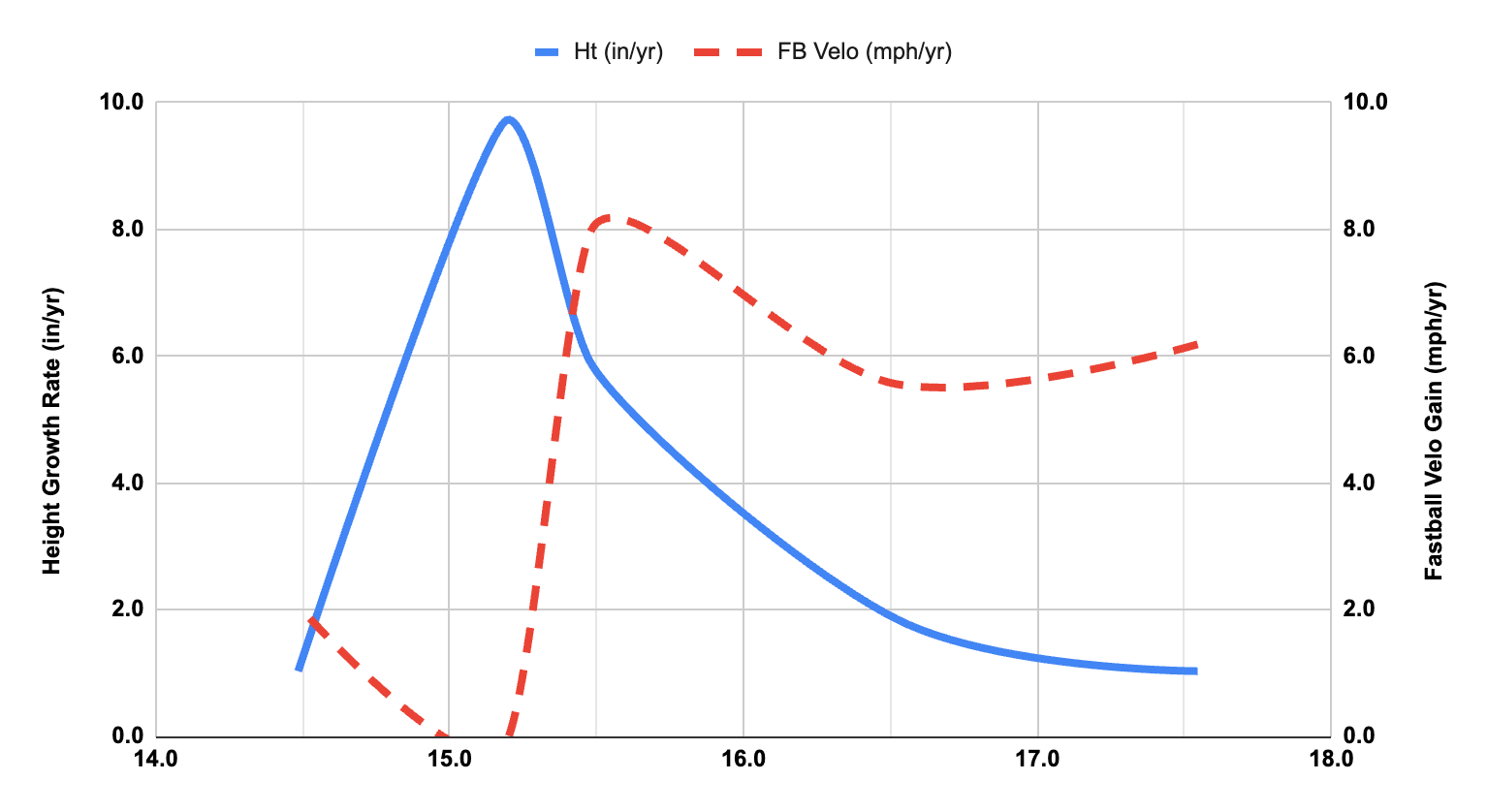
The other aspect of this graph to pay attention to is the decline in the rate of fastball velocity gain during the growth spurt, which was also reported in the previous case study. It is also important to highlight again the significant gain in fastball velocity post-PHV. Again, this is often the time of peak weight velocity and significant gain in lean body mass in boys. In fact, much of the gain in Cecconi’s fastball velocity occurred from the ages of 15 to 18 years. A 20-mph increase from 76 to 96 mph.
In comparison to the modeled data for MLB pitchers, it is quite evident that Cecconi lagged behind the often early maturing flamethrowers - particularly at age 15 when the early maturer boy is packing on lean body mass and velo is shooting up. Remember this is when Cecconi was just hitting PHV! About 2 years after the early maturers who are also getting selected onto “elite” teams and perhaps starting to draw attention of college coaches and scouts.
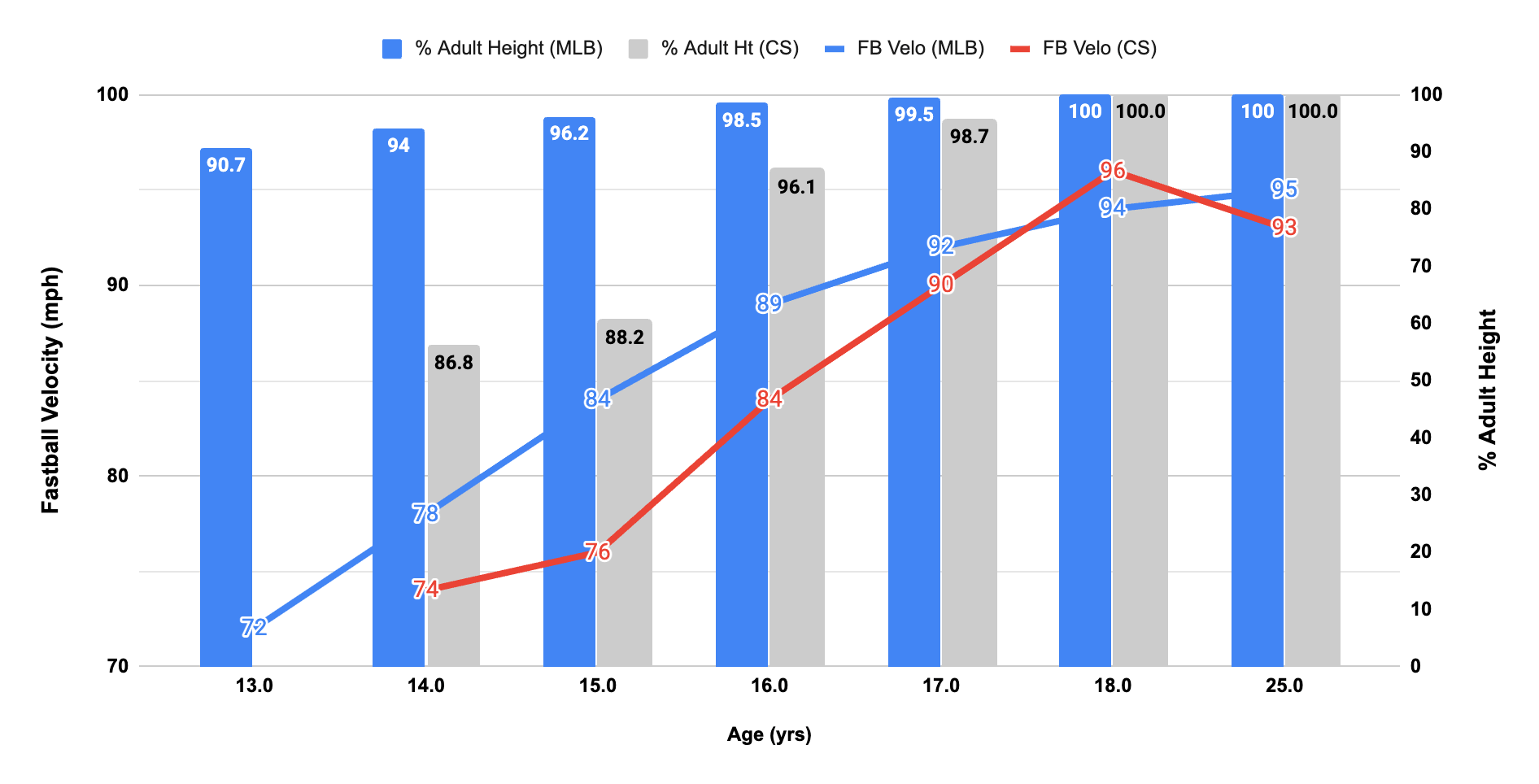
But, this is also the tale of patience and letting puberty do its thing. Because at the age of 17-18 years, he catches up to everyone. And, this is the real time when it matters, as college coaches and scouts see what they will get the following year. It’s like the weather. The 10-day forecast can be off. The 3-day forecast is pretty good. But the next day or the hourly forecast is usually quite accurate.
Following high school (2018), he was drafted in the 38th round by the Baltimore Orioles but opted to play college baseball for the University of Miami. In the Cressey podcast, he commented about gaining 20 lbs as a freshman. In the 2020 Draft, he was selected by the Arizona Diamondbacks and began his professional career.
Summary of Key Findings
Cecconi grew 16 inches from 5-6 to 604 from the age of 14.0 to the age of 18.0 years. At 14.0 years of age, he was slighly taller than the 50th percentile of the growth chart. The average (50th percentile) boy will grow about 5 inches from 64.6 inches to 69.4 inches from 14 to 18 years of age.
The estimated age at PHV was about age 15.2 yrs based on the growth rate curve, identifying CS as a late maturing boy.
There was a decrease in fastball velocity gain during the adolescent growth spurt, and a significant increase about 1 yr later. This gain in fastball velocity continued throughout late adolescence. “First you stretch them, then you fill them out.”
From about the time of post-PHV or the ages of 15 to 18 years, there was a 20-mph increase in fastball velocity from 76 to 96 mph.
Implications
First and foremost, in a sport often dominated by early maturing boys (see Maturity Matters: The Story of 12U USA Baseball), it is important to provide opportunity and development to the late maturing boy.
Are there implications for bio-banding in baseball? I’m just going to leave this one here for awhile…..
Physical growth and maturation of the young, developing pitcher may impact fastball velocity. It is possible that throwing velocity may be impacted by the adolescent growth spurt, which may be due to coordination and muscular strength.
Given the efforts in assessing performance metrics at these showcase/combine events, it is recommended that standardized procedures be used to measure height and weight given their impact on performance, and perhaps injury risk, during adolescence.
There are large gains in fastball velocity post-PHV / late adolescence as males generally show a large increase in lean body mass and skeletal muscle mass. In addition, there could also be related to changes in muscular strength and power along with refinements and mastery of motor skill acquisition and biomechanics.
Again, don’t give up on late maturers!
How to cite this article: JC Eisenmann. Growing Into Velocity: A Longitudinal Case Study of the Physical Growth & Maturation of a Late Maturing MLB Pitcher. Archives of IronMan Performance. Vol 1, 2026. [joeeisenmann.substack.com]
There’s alot more on growth and maturation, youth athletic development, and baseball on the Substack. Please explore and subscribe.
☕️ Or if you don’t want to pay to subscribe, but ever feel like getting me a coffee ☕️ — you can! There is a cool site which allows people to ‘tip’ or get me a ’sip’ or cup of Joe! Click here: https://ko-fi.com/joeeisenmann