

Talent Identification and Development in Youth Basketball
March Madness (part V)

Here we are - the Sweet 16, the Elite 8, and The Final Four. The pinnacle of college basketball in the US.
How did these athlete get here? How were they identified and selected to top NCAA collegiate programs, now playing on the big stage in the Big Dance?
How did they (or how should they) develop to become some of the top players?
In part V of the March Madness series, we focus on talent identification and development in youth basketball highlighting three review papers.
Impact of the Relative Age Effect on Competition Performance in Basketball: A Qualitative Systematic Review. de la Rubia Riaza A, Lorenzo Calvo J, Mon-López D, Lorenzo A. Int J Environ Res Public Health. 2020 Nov 19;17(22):8596.
Basketball talent identification: a systematic review and meta-analysis of the anthropometric, physiological and physical performance factors. Han M, Gómez-Ruano MA, Calvo AL, Calvo JL. Front Sports Act Living. 2023 Nov 14;5:1264872.
The NBA and Youth Basketball: Recommendations for Promoting a Healthy and Positive Experience. DiFiori JP, Güllich A, Brenner JS, Côté J, Hainline B, Ryan E 3rd, Malina RM. Sports Med. 2018 Sep;48(9):2053-2065.
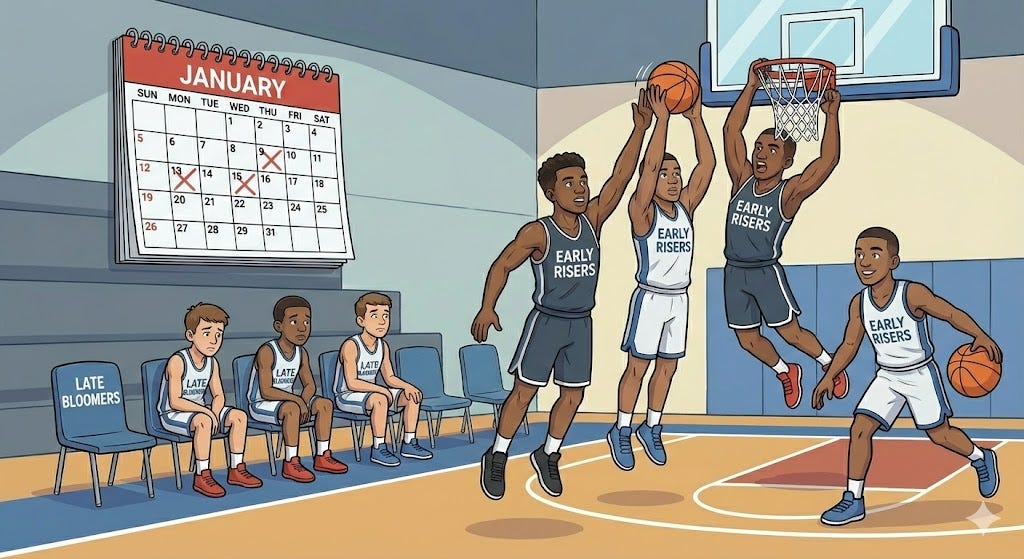
Talent Identification and Selection in Youth Basketball
The following two review papers suggest that the identification and selection of youth basketball talent is strongly influenced by relative age, body size and early biological maturity, which produces a bias toward early-developing players. Friends, we have heard this story before (see Fair Play: Overcoming Bias in Youth Sports Talent Identification).
Yet, long-term success in senior or professional basketball depends on a broader set of qualities—speed, power, and skill development—rather than simply early physical advantage.
Conclusion: Many youth programs are selecting the currently best player, not the future best player, emphasizing the need to incorporate maturation assessment and long-term development models into basketball talent identification systems.
Read full review paper here:
Impact of the Relative Age Effect on Competition Performance in Basketball: A Qualitative Systematic Review. de la Rubia Riaza A, Lorenzo Calvo J, Mon-López D, Lorenzo A. Int J Environ Res Public Health. 2020 Nov 19;17(22):8596.
Basketball Talent Identification: a systematic review and meta-analysis of the anthropometric, physiological and physical performance factors. Han M, Gómez-Ruano MA, Calvo AL, Calvo JL. Front Sports Act Living. 2023 Nov 14;5:1264872.
Talent Development: The NBA and USA Basketball Recommendations
In 2016, the Jr. NBA partnered with USA Basketball to address the growing concerns about early specialization, overuse injuries, burnout, and the professionalization of youth basketball in the USA. As part of this initiative, a multidisciplinary team of sports medicine clinicians and researchers with expertise in athlete development and youth sports assessed the existing research and authored a consensus paper that included the following recommendations for best practice in youth basketball.
1. Delay Specialization
Encourage multi-sport participation through at least early adolescence
Promote broad motor skill development
Early diversification is associated with better long-term performance and lower injury risk
2. Improve Practice-to-Game Ratio
Practices should exceed games, especially before high school
Skill development and physical literacy are prioritized over competition outcomes
3. Limit Workload
The paper recommends:
Scheduled rest periods during the year
No year-round single-sport participation
Monitoring cumulative load across teams and leagues
4. Age-Appropriate Competition
Modify the game environment for children to increase involvement, skill touches, and learning.
Smaller courts
Lower hoops
Fewer players
Shorter game durations
5. Promote Physical Development
Include structured preparation:
Fundamental movement skills
Strength and neuromuscular training
Injury-prevention exercises
Gradual progression during adolescent growth spurt
6. Support Psychosocial Development
Focus on:
Fun and enjoyment
Autonomy and motivation
Positive coaching climate
Long-term participation rather than early selection
Take Home Message: The authors emphasize a shift from “early talent identification” to “long-term talent development.” Evidence shows many elite basketball players were not early standouts and benefited from diversified sport experiences and progressive training.
Read full review paper here:
The NBA and Youth Basketball: Recommendations for Promoting a Healthy and Positive Experience. DiFiori JP, Güllich A, Brenner JS, Côté J, Hainline B, Ryan E 3rd, Malina RM. Sports Med. 2018 Sep;48(9):2053-2065.
If you are interested in this article, you may also like this one …..